Achieving Uniform White Field Performance Across Large LED Video Walls
Why White Uniformity Matters in LED Display Projects
When discussing LED display image quality, many people focus on brightness, contrast ratio, color gamut, or refresh rate.
However, one often-overlooked factor can significantly affect the visual performance of large LED video walls:
White Field Uniformity.
A display may look perfect when a single cabinet or module is tested individually. Yet once dozens or even hundreds of cabinets are assembled into a large screen, subtle differences in brightness and color temperature can become visible.
These inconsistencies create noticeable panel boundaries, resulting in a less professional visual appearance.
Contact Us to Discuss Your Project Today
White Balance vs. White Field Uniformity
Many people mistakenly assume these two concepts are the same.
White Balance
White balance refers to the calibration of a single LED module or cabinet by adjusting the RGB channels to produce a standard white output.
The goal is to eliminate color shifts within an individual module.
White Field Uniformity
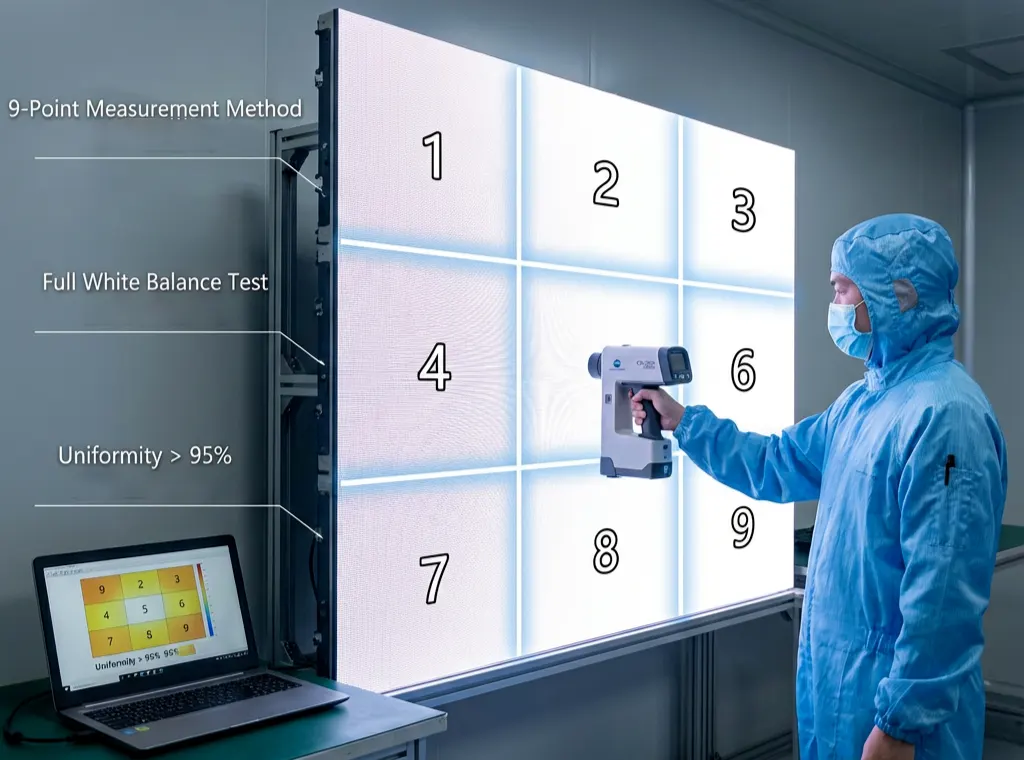
White field uniformity refers to the consistency of brightness and color temperature across the entire LED video wall after multiple cabinets are assembled.
Even if every cabinet has been calibrated individually, differences between cabinets may still become visible when displaying full-white content.
A display with excellent white field uniformity should appear as one seamless visual surface without visible cabinet boundaries.
What Causes White Field Inconsistency?
Several factors can contribute to visible differences between LED cabinets.
1. Component Variations
Even LEDs from the same production batch may have slight differences in:
- Brightness
- Color temperature
- Wavelength characteristics
Similarly, driver IC output variations can introduce minor discrepancies.
While these differences may be negligible on a single cabinet, they become much more noticeable on large displays.
2. Temperature Differences
Temperature directly affects LED performance.
In a large video wall:
- Center cabinets often operate at higher temperatures
- Edge cabinets remain cooler
- Heat distribution is rarely perfectly uniform
As temperature changes, brightness and color characteristics also change.
As a result, the screen may exhibit visible brightness gradients during operation.
3. Aging Differences
Temperature directly affects LED performance.
LED components age gradually over time.
Cabinets that have:
Different operating hours
Different maintenance histories
Different environmental exposure
may develop visible brightness variations.
This often appears as darker or slightly yellowish sections on older installations.
4. Incomplete Calibration
Many displays only undergo cabinet-level calibration.
This approach can improve individual cabinet performance but does not guarantee consistency across the entire assembled screen.
Without full-screen calibration, large video walls may still show visible transitions between cabinets.
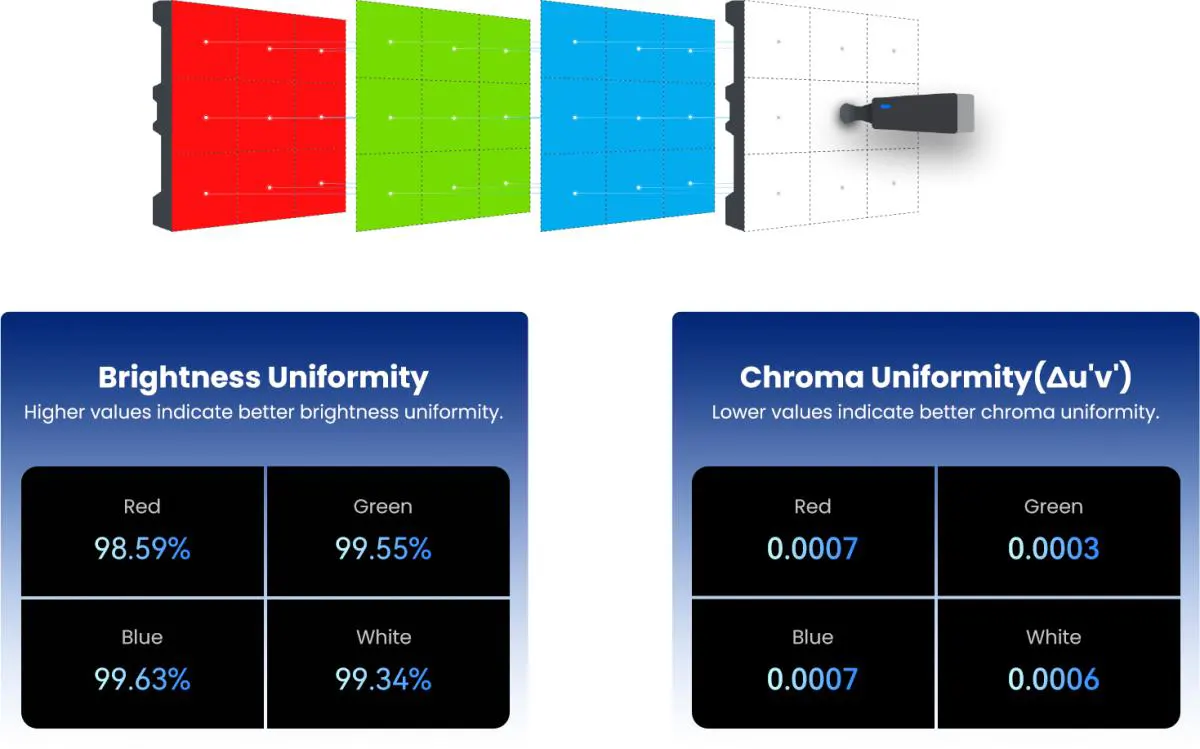
How Professional LED Manufacturers Achieve Better White Field Uniformity
Achieving excellent white uniformity requires more than simple calibration.
Modern LED manufacturers typically employ multiple control measures throughout production.
Component Binning and Classification
LEDs are grouped according to:
- Brightness
- Color coordinates
- Wavelength consistency
Using tightly matched components helps minimize variations from the beginning.
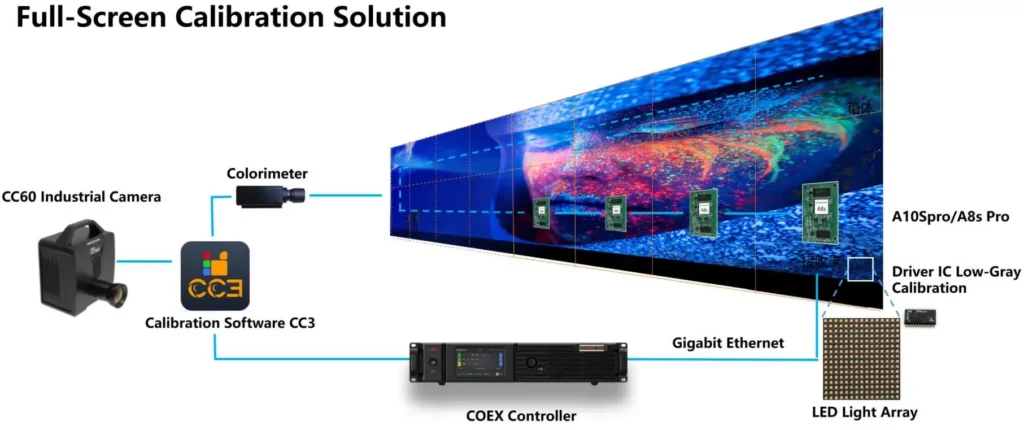
Full-Screen Calibration
Rather than calibrating cabinets individually, the entire assembled display is measured and calibrated as a single visual surface.
This process ensures all cabinets meet the same reference standard.
Benefits include:
- Better brightness consistency
- Improved color uniformity
- Reduced cabinet boundaries
Dynamic Temperature Compensation
Advanced systems monitor cabinet temperatures in real time.
As temperature changes occur, the display automatically adjusts RGB drive values to maintain consistent visual performance.
Benefits include:
- More stable colors
- Better brightness control
- Improved long-term consistency
Aging Compensation
After extended operation, professional maintenance procedures can compensate for brightness degradation caused by LED aging.
This helps maintain uniform appearance throughout the display lifecycle.
Signal Path Consistency
Professional control systems ensure all cabinets receive synchronized signal processing and calibration data.
This prevents visible differences caused by inconsistent signal output.
Why White Field Uniformity Is Critical
Many display issues only become visible under specific content conditions.
For example:
- Full white backgrounds
- Light gray presentations
- Conference room applications
- Control room dashboards
- Broadcast studio environments
In these scenarios, even small cabinet-to-cabinet differences can become immediately noticeable.
A display may perform well with colorful content but reveal visible inconsistencies when showing neutral backgrounds.
This is why professional LED manufacturers place significant emphasis on white field uniformity during production and calibration.
Applications Where Uniformity Matters Most
White field consistency is especially important in:
Corporate Meeting Rooms
Presentations often contain large white backgrounds.
Control Rooms
Operators require accurate and consistent image performance.
Broadcast Studios
Camera systems can easily detect color and brightness differences.
Virtual Production Studios
Uniform visual surfaces are essential for realistic digital environments.
High-End Commercial Displays
Premium installations demand seamless visual performance
Conclusion
White balance calibration ensures that an individual LED module produces accurate white output.
White field uniformity goes a step further by ensuring that an entire LED video wall appears visually consistent after assembly.
Achieving this level of performance requires:
Strict component selection
Full-screen calibration
Temperature compensation
Aging management
Signal synchronization
For professional LED installations, white field uniformity is often one of the most important indicators of overall display quality.
A truly premium LED video wall should appear as a single seamless display—not as a collection of individual cabinets.
Achieving Uniform White Field Performance Across Large LED Video Walls
Why White Uniformity Matters in LED Display Projects
When discussing LED display image quality, many people focus on brightness, contrast ratio, color gamut, or refresh rate.
However, one often-overlooked factor can significantly affect the visual performance of large LED video walls:
White Field Uniformity.
A display may look perfect when a single cabinet or module is tested individually. Yet once dozens or even hundreds of cabinets are assembled into a large screen, subtle differences in brightness and color temperature can become visible.
These inconsistencies create noticeable panel boundaries, resulting in a less professional visual appearance.
Contact Us to Discuss Your Project Today
White Balance vs. White Field Uniformity
Many people mistakenly assume these two concepts are the same.
White Balance
White balance refers to the calibration of a single LED module or cabinet by adjusting the RGB channels to produce a standard white output.
The goal is to eliminate color shifts within an individual module.
White Field Uniformity
White field uniformity refers to the consistency of brightness and color temperature across the entire LED video wall after multiple cabinets are assembled.
Even if every cabinet has been calibrated individually, differences between cabinets may still become visible when displaying full-white content.
A display with excellent white field uniformity should appear as one seamless visual surface without visible cabinet boundaries.
What Causes White Field Inconsistency?
Several factors can contribute to visible differences between LED cabinets.
1. Component Variations
Even LEDs from the same production batch may have slight differences in:
- Brightness
- Color temperature
- Wavelength characteristics
Similarly, driver IC output variations can introduce minor discrepancies.
While these differences may be negligible on a single cabinet, they become much more noticeable on large displays.
2. Temperature Differences
Temperature directly affects LED performance.
In a large video wall:
- Center cabinets often operate at higher temperatures
- Edge cabinets remain cooler
- Heat distribution is rarely perfectly uniform
As temperature changes, brightness and color characteristics also change.
As a result, the screen may exhibit visible brightness gradients during operation.
3. Aging Differences
Temperature directly affects LED performance.
LED components age gradually over time.
Cabinets that have:
Different operating hours
Different maintenance histories
Different environmental exposure
may develop visible brightness variations.
This often appears as darker or slightly yellowish sections on older installations.
4. Incomplete Calibration
Many displays only undergo cabinet-level calibration.
This approach can improve individual cabinet performance but does not guarantee consistency across the entire assembled screen.
Without full-screen calibration, large video walls may still show visible transitions between cabinets.
How Professional LED Manufacturers Achieve Better White Field Uniformity
Achieving excellent white uniformity requires more than simple calibration.
Modern LED manufacturers typically employ multiple control measures throughout production.
Component Binning and Classification
LEDs are grouped according to:
- Brightness
- Color coordinates
- Wavelength consistency
Using tightly matched components helps minimize variations from the beginning.
Full-Screen Calibration
Rather than calibrating cabinets individually, the entire assembled display is measured and calibrated as a single visual surface.
This process ensures all cabinets meet the same reference standard.
Benefits include:
- Better brightness consistency
- Improved color uniformity
- Reduced cabinet boundaries
Dynamic Temperature Compensation
Advanced systems monitor cabinet temperatures in real time.
As temperature changes occur, the display automatically adjusts RGB drive values to maintain consistent visual performance.
Benefits include:
- More stable colors
- Better brightness control
- Improved long-term consistency
Aging Compensation
After extended operation, professional maintenance procedures can compensate for brightness degradation caused by LED aging.
This helps maintain uniform appearance throughout the display lifecycle.
Signal Path Consistency
Professional control systems ensure all cabinets receive synchronized signal processing and calibration data.
This prevents visible differences caused by inconsistent signal output.
Why White Field Uniformity Is Critical
Many display issues only become visible under specific content conditions.
For example:
- Full white backgrounds
- Light gray presentations
- Conference room applications
- Control room dashboards
- Broadcast studio environments
In these scenarios, even small cabinet-to-cabinet differences can become immediately noticeable.
A display may perform well with colorful content but reveal visible inconsistencies when showing neutral backgrounds.
This is why professional LED manufacturers place significant emphasis on white field uniformity during production and calibration.
Applications Where Uniformity Matters Most
White field consistency is especially important in:
Corporate Meeting Rooms
Presentations often contain large white backgrounds.
Control Rooms
Operators require accurate and consistent image performance.
Broadcast Studios
Camera systems can easily detect color and brightness differences.
Virtual Production Studios
Uniform visual surfaces are essential for realistic digital environments.
High-End Commercial Displays
Premium installations demand seamless visual performance
Conclusion
White balance calibration ensures that an individual LED module produces accurate white output.
White field uniformity goes a step further by ensuring that an entire LED video wall appears visually consistent after assembly.
Achieving this level of performance requires:
Strict component selection
Full-screen calibration
Temperature compensation
Aging management
Signal synchronization
For professional LED installations, white field uniformity is often one of the most important indicators of overall display quality.
A truly premium LED video wall should appear as a single seamless display—not as a collection of individual cabinets.

 +86 19075683597
 Shenzhen, China