What Is Flip-Chip COB Technology?
A Complete Guide to Next-Generation LED Displays
As LED display technology continues to evolve toward smaller pixel pitches, higher contrast ratios, and lower power consumption, traditional packaging methods are approaching their physical limits.
One of the most significant innovations in recent years is Flip-Chip COB (Chip-on-Board) technology, often considered the next step beyond conventional SMD and standard COB displays.
By eliminating wire bonding and mounting LED chips directly onto the PCB in an inverted configuration, Flip-Chip COB delivers higher reliability, improved thermal performance, greater energy efficiency, and superior visual quality.
Today, Flip-Chip COB is increasingly used in command centers, broadcast studios, premium conference rooms, virtual production stages, and other mission-critical applications.
What Is Flip-Chip COB Technology?
Flip-Chip COB combines two advanced technologies:
- Flip-Chip LED
- Chip-on-Board (COB)
In a conventional LED package, electrical connections are made using microscopic bonding wires.
In Flip-Chip technology, the LED chip is mounted upside down directly onto the substrate, eliminating the need for wire bonding.
The result is a more efficient and reliable electrical structure.
How Does Flip-Chip Differ from Conventional LEDs?
Traditional SMD Structure
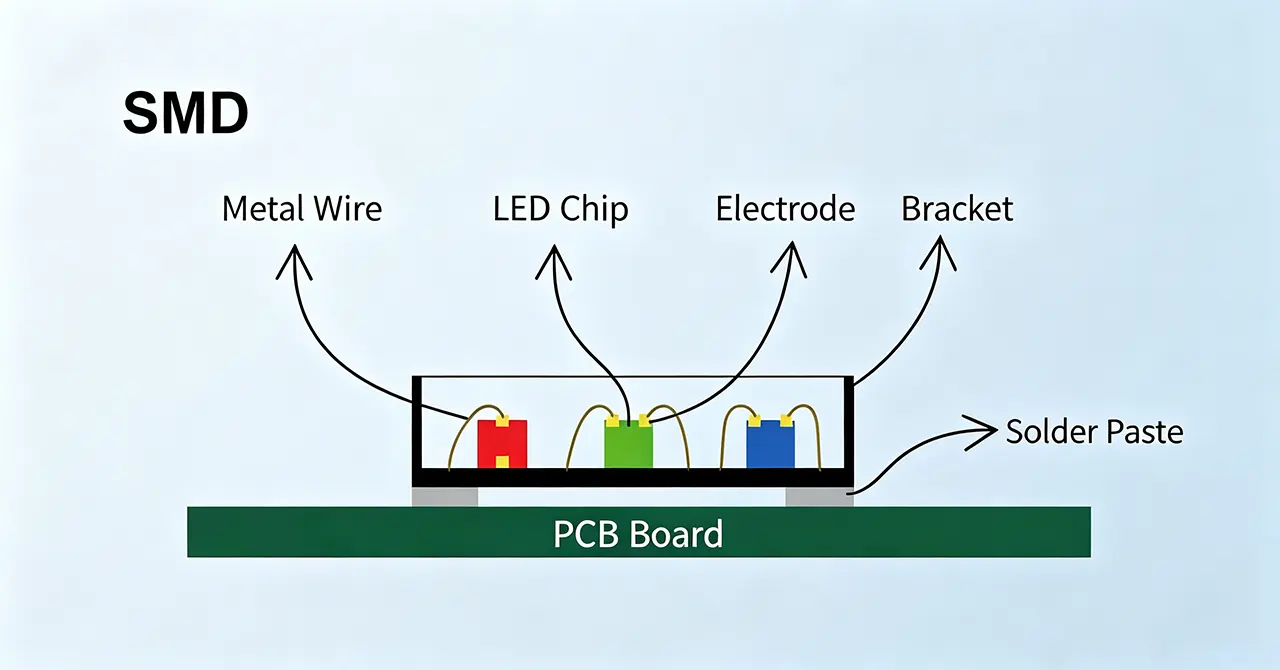
Traditional SMD LEDs contain:
- RGB LED chips
- Bonding wires
- Lead frame
- Encapsulation package
Potential failure points include:
- Wire breakage
- Corrosion
- Thermal stress
- Package damage
Standard COB Structure
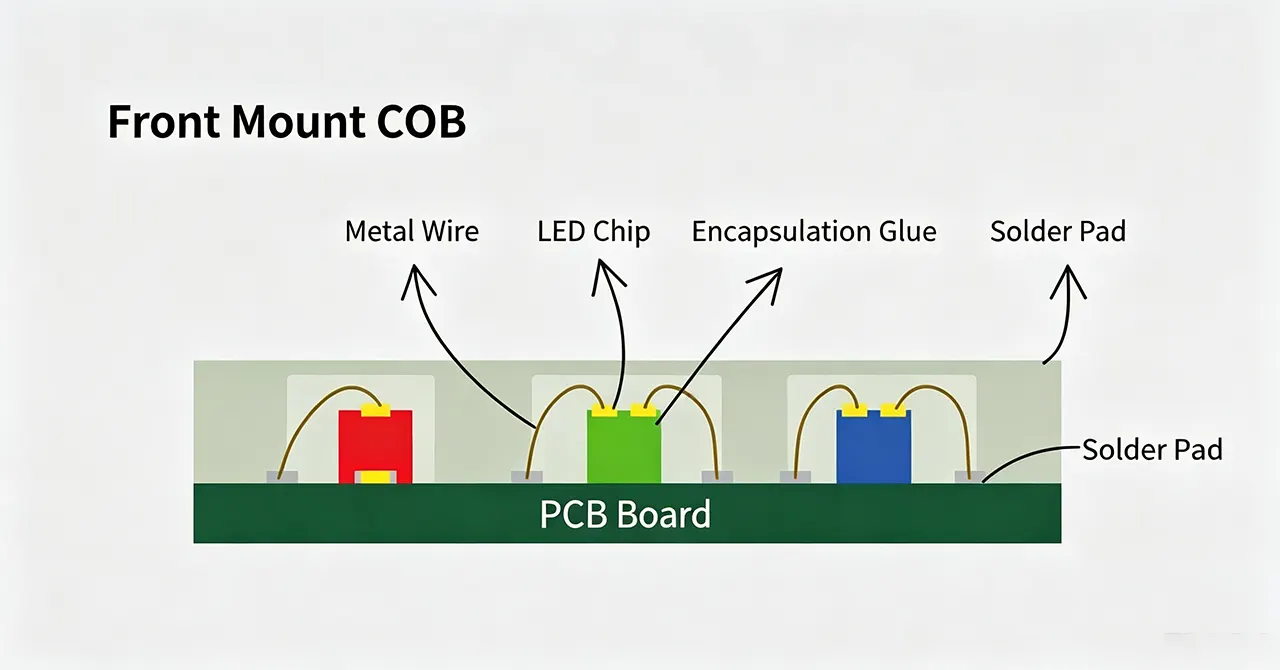
Standard COB removes the individual package but still relies on chip interconnection technologies.
Advantages include:
- Better protection
- Higher contrast
- Improved heat dissipation
Flip-Chip COB Structure
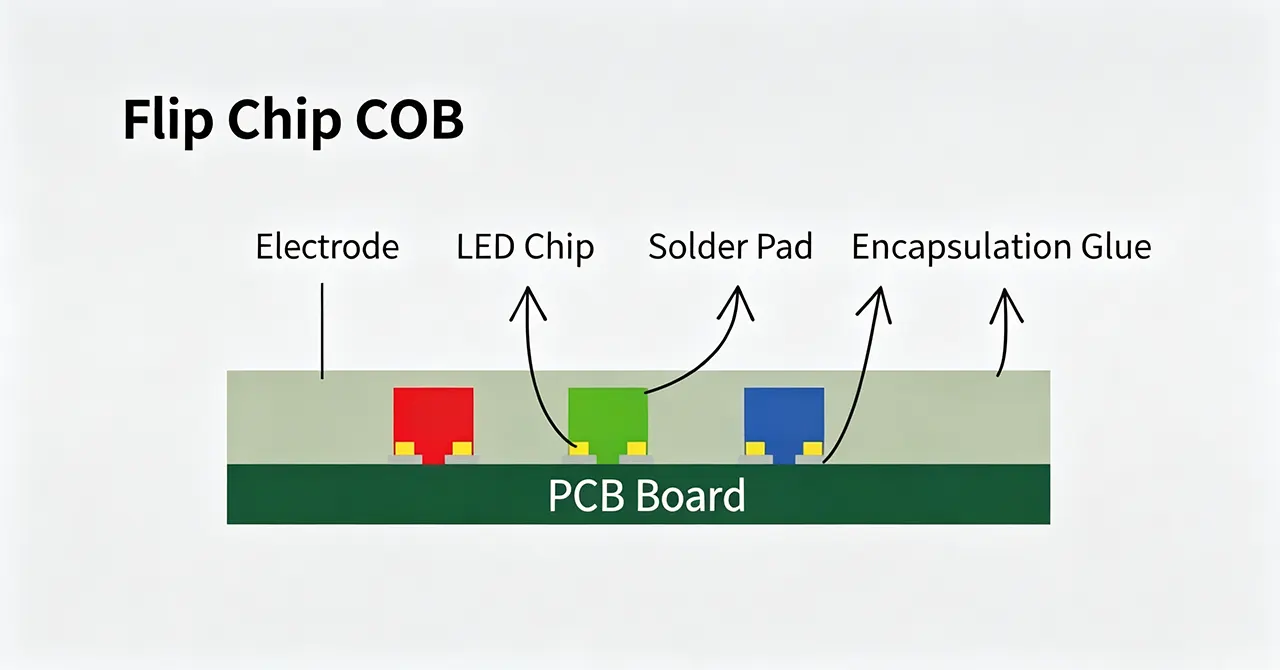
Flip-Chip COB directly mounts the LED chip onto the PCB using metal contacts located on the bottom of the chip.
Key advantages include:
- No bonding wires
- Shorter electrical path
- Lower resistance
- Better thermal conductivity
- Higher reliability
This creates one of the most advanced LED display architectures currently available.
Why Was Flip-Chip Technology Developed?
As pixel pitches continue shrinking below P1.0, manufacturers face several challenges:
- Increased heat density
- Higher power consumption
- Reduce package size
- Reliability concerns
Traditional wire-bonded structures become increasingly difficult to manufacture at ultra-fine pixel pitches.
Flip-Chip technology was developed to overcome these limitations.
| Pixel Pitch | Typical Technology Trend |
|---|---|
| P1.5 – P1.2 | SMD / COB |
| P1.2 – P0.9 | COB Growing Rapidly |
| P0.9 – P0.6 | Flip-Chip COB |
| Below P0.6 | Future Micro LED Direction |
Manufacturing Process of Flip-Chip COB
Step 1: Wafer Preparation
LED chips are fabricated on semiconductor wafers using advanced epitaxial growth and lithography processes.
Step 2: Electrode Formation
Electrical contacts are formed on the chip surface to allow direct connection to the PCB substrate.
Step 3: Chip Flipping
The chip is inverted so that the electrodes face downward toward the PCB.
Step 4: Direct Mounting
The LED chip is mounted directly onto the PCB using high-precision equipment.
Step 5: COB Encapsulation
The display surface is protected with advanced optical encapsulation materials that improve durability and optical performance.
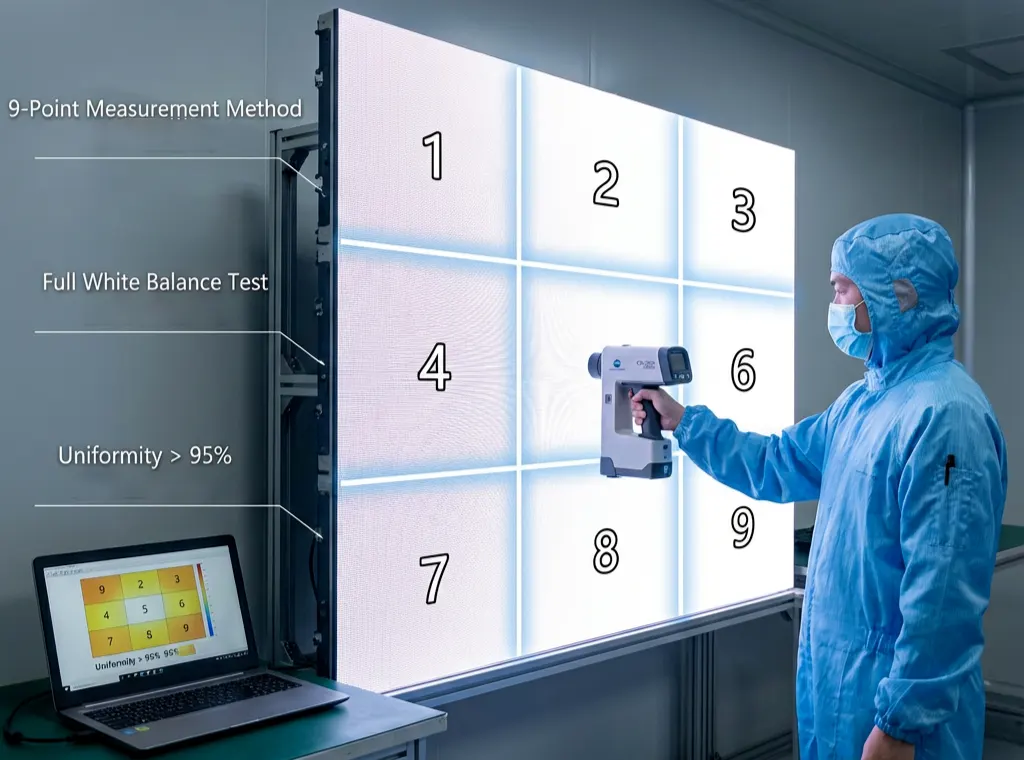
Step 6: Calibration and Testing
- Brightness Calibration
- Color Calibration
- Thermal Testing
- Reliability Verification
- Burn-In Testing
Key Advantages of Flip-Chip COB Technology
1. Higher Reliability
One of the biggest advantages of Flip-Chip technology is the complete elimination of bonding wires.
Without wire bonds, common failure mechanisms such as wire fatigue, corrosion, and bond detachment are significantly reduced.
2. Superior Heat Dissipation
Heat is one of the primary factors affecting LED lifespan.
In Flip-Chip structures, heat is transferred directly through the chip into the PCB substrate, creating a much more efficient thermal path.
Benefits include:
- Lower junction temperature
- Improved thermal stability
- Longer service life
- Enhanced reliability
3. Lower Power Consumption
Improved electrical efficiency enables Flip-Chip LEDs to consume less power while maintaining high brightness levels.
Depending on display design and operating conditions, power savings can reach 20% to 40% compared with conventional technologies.
4. Higher Brightness Efficiency
Traditional bonding wires partially block light output.
By eliminating these wires, Flip-Chip LEDs achieve improved optical efficiency and brightness utilization.
5. Exceptional Contrast Ratio
Combined with COB encapsulation, Flip-Chip displays deliver:
- Lower reflectivity
- Deeper black levels
- Enhanced HDR performance
- Improved image depth
6. Ultra-Fine Pixel Pitch Capability
Flip-Chip COB excels in ultra-high-resolution displays.
Typical applications include:
- P0.9
- P0.7
- P0.6
- P0.4
Flip-Chip COB vs Standard COB
| Feature | Standard COB | Flip-Chip COB |
|---|---|---|
| Wire Bonding | Required | Not Required |
| Reliability | High | Very High |
| Heat Dissipation | Excellent | Superior |
| Power Efficiency | High | Higher |
| Brightness Efficiency | High | Higher |
| Manufacturing Complexity | High | Very High |
| Cost | High | Higher |
Flip-Chip COB vs SMD
| Feature | SMD | Flip-Chip COB |
|---|---|---|
| Packaging Method | Individual Packages | Direct Chip Mounting |
| Surface Protection | Moderate | Excellent |
| Contrast Ratio | High | Very High |
| Heat Dissipation | Good | Excellent |
| Energy Efficiency | Good | Excellent |
| Fine-Pitch Capability | Good | Excellent |
| Maintenance | Easier | More Complex |
| Cost | Lower | Higher |
Typical Applications
Command and Control Centers
Mission-critical environments require exceptional reliability, continuous operation, and outstanding image quality.
Broadcast Studios
Superior contrast ratios and black levels help improve on-camera performance.
Corporate Meeting Rooms
Fine-pitch Flip-Chip displays deliver premium visual experiences for presentations and video conferencing.
Virtual Production Studios
Film and television production increasingly rely on high-performance LED walls for immersive content creation.
Luxury Retail and Showrooms
Premium brands use Flip-Chip displays to create visually stunning customer experiences.
Challenges of Flip-Chip COB Technology
Higher Manufacturing Cost
Advanced equipment and tighter process controls increase production costs.
More Complex Production
Yield management and process stability requirements are significantly higher than traditional SMD production.
Premium Market Positioning
Flip-Chip COB is currently targeted primarily at high-end commercial and professional applications.
Future Outlook
Many industry experts believe Flip-Chip COB represents the future of fine-pitch LED display technology.
Key industry trends include:
- Smaller pixel pitches
- Lower energy consumption
- Higher contrast ratios
- Improved reliability
- Wider adoption of HDR content
As manufacturing costs continue to decrease, Flip-Chip COB is expected to become increasingly common across commercial display applications.
Conclusion
Flip-Chip COB combines the protection advantages of COB technology with the efficiency benefits of flip-chip architecture.
By eliminating bonding wires and improving thermal performance, it delivers higher reliability, lower power consumption, superior contrast ratios, and exceptional fine-pitch performance.
For premium indoor applications where image quality, reliability, and long-term performance are critical, Flip-Chip COB is widely regarded as one of the most advanced LED display technologies available today.
Contact Us to Discuss Your Project Today
What Is Flip-Chip COB Technology?
A Complete Guide to Next-Generation LED Displays
As LED display technology continues to evolve toward smaller pixel pitches, higher contrast ratios, and lower power consumption, traditional packaging methods are approaching their physical limits.
One of the most significant innovations in recent years is Flip-Chip COB (Chip-on-Board) technology, often considered the next step beyond conventional SMD and standard COB displays.
By eliminating wire bonding and mounting LED chips directly onto the PCB in an inverted configuration, Flip-Chip COB delivers higher reliability, improved thermal performance, greater energy efficiency, and superior visual quality.
Today, Flip-Chip COB is increasingly used in command centers, broadcast studios, premium conference rooms, virtual production stages, and other mission-critical applications.
What Is Flip-Chip COB Technology?
Flip-Chip COB combines two advanced technologies:
- Flip-Chip LED
- Chip-on-Board (COB)
In a conventional LED package, electrical connections are made using microscopic bonding wires.
In Flip-Chip technology, the LED chip is mounted upside down directly onto the substrate, eliminating the need for wire bonding.
The result is a more efficient and reliable electrical structure.
How Does Flip-Chip Differ from Conventional LEDs?
Traditional SMD Structure
Traditional SMD LEDs contain:
- RGB LED chips
- Bonding wires
- Lead frame
- Encapsulation package
Potential failure points include:
- Wire breakage
- Corrosion
- Thermal stress
- Package damage
Standard COB Structure
Standard COB removes the individual package but still relies on chip interconnection technologies.
Advantages include:
- Better protection
- Higher contrast
- Improved heat dissipation
Flip-Chip COB Structure
Flip-Chip COB directly mounts the LED chip onto the PCB using metal contacts located on the bottom of the chip.
Key advantages include:
- No bonding wires
- Shorter electrical path
- Lower resistance
- Better thermal conductivity
- Higher reliability
This creates one of the most advanced LED display architectures currently available.
Why Was Flip-Chip Technology Developed?
As pixel pitches continue shrinking below P1.0, manufacturers face several challenges:
- Increased heat density
- Higher power consumption
- Reduce package size
- Reliability concerns
Traditional wire-bonded structures become increasingly difficult to manufacture at ultra-fine pixel pitches.
Flip-Chip technology was developed to overcome these limitations.
| Pixel Pitch | Typical Technology Trend |
|---|---|
| P1.5 – P1.2 | SMD / COB |
| P1.2 – P0.9 | COB Growing Rapidly |
| P0.9 – P0.6 | Flip-Chip COB |
| Below P0.6 | Future Micro LED Direction |
Manufacturing Process of Flip-Chip COB
Step 1: Wafer Preparation
LED chips are fabricated on semiconductor wafers using advanced epitaxial growth and lithography processes.
Step 2: Electrode Formation
Electrical contacts are formed on the chip surface to allow direct connection to the PCB substrate.
Step 3: Chip Flipping
The chip is inverted so that the electrodes face downward toward the PCB.
Step 4: Direct Mounting
The LED chip is mounted directly onto the PCB using high-precision equipment.
Step 5: COB Encapsulation
The display surface is protected with advanced optical encapsulation materials that improve durability and optical performance.
Step 6: Calibration and Testing
- Brightness Calibration
- Color Calibration
- Thermal Testing
- Reliability Verification
- Burn-In Testing
Key Advantages of Flip-Chip COB Technology
1. Higher Reliability
One of the biggest advantages of Flip-Chip technology is the complete elimination of bonding wires.
Without wire bonds, common failure mechanisms such as wire fatigue, corrosion, and bond detachment are significantly reduced.
2. Superior Heat Dissipation
Heat is one of the primary factors affecting LED lifespan.
In Flip-Chip structures, heat is transferred directly through the chip into the PCB substrate, creating a much more efficient thermal path.
Benefits include:
- Lower junction temperature
- Improved thermal stability
- Longer service life
- Enhanced reliability
3. Lower Power Consumption
Improved electrical efficiency enables Flip-Chip LEDs to consume less power while maintaining high brightness levels.
Depending on display design and operating conditions, power savings can reach 20% to 40% compared with conventional technologies.
4. Higher Brightness Efficiency
Traditional bonding wires partially block light output.
By eliminating these wires, Flip-Chip LEDs achieve improved optical efficiency and brightness utilization.
5. Exceptional Contrast Ratio
Combined with COB encapsulation, Flip-Chip displays deliver:
- Lower reflectivity
- Deeper black levels
- Enhanced HDR performance
- Improved image depth
6. Ultra-Fine Pixel Pitch Capability
Flip-Chip COB excels in ultra-high-resolution displays.
Typical applications include:
- P0.9
- P0.7
- P0.6
- P0.4
Flip-Chip COB vs Standard COB
| Feature | Standard COB | Flip-Chip COB |
|---|---|---|
| Wire Bonding | Required | Not Required |
| Reliability | High | Very High |
| Heat Dissipation | Excellent | Superior |
| Power Efficiency | High | Higher |
| Brightness Efficiency | High | Higher |
| Manufacturing Complexity | High | Very High |
| Cost | High | Higher |
Flip-Chip COB vs SMD
| Feature | SMD | Flip-Chip COB |
|---|---|---|
| Packaging Method | Individual Packages | Direct Chip Mounting |
| Surface Protection | Moderate | Excellent |
| Contrast Ratio | High | Very High |
| Heat Dissipation | Good | Excellent |
| Energy Efficiency | Good | Excellent |
| Fine-Pitch Capability | Good | Excellent |
| Maintenance | Easier | More Complex |
| Cost | Lower | Higher |
Typical Applications
Command and Control Centers
Mission-critical environments require exceptional reliability, continuous operation, and outstanding image quality.
Broadcast Studios
Superior contrast ratios and black levels help improve on-camera performance.
Corporate Meeting Rooms
Fine-pitch Flip-Chip displays deliver premium visual experiences for presentations and video conferencing.
Virtual Production Studios
Film and television production increasingly rely on high-performance LED walls for immersive content creation.
Luxury Retail and Showrooms
Premium brands use Flip-Chip displays to create visually stunning customer experiences.
Challenges of Flip-Chip COB Technology
Higher Manufacturing Cost
Advanced equipment and tighter process controls increase production costs.
More Complex Production
Yield management and process stability requirements are significantly higher than traditional SMD production.
Premium Market Positioning
Flip-Chip COB is currently targeted primarily at high-end commercial and professional applications.
Future Outlook
Many industry experts believe Flip-Chip COB represents the future of fine-pitch LED display technology.
Key industry trends include:
- Smaller pixel pitches
- Lower energy consumption
- Higher contrast ratios
- Improved reliability
- Wider adoption of HDR content
As manufacturing costs continue to decrease, Flip-Chip COB is expected to become increasingly common across commercial display applications.
Conclusion
Flip-Chip COB combines the protection advantages of COB technology with the efficiency benefits of flip-chip architecture.
By eliminating bonding wires and improving thermal performance, it delivers higher reliability, lower power consumption, superior contrast ratios, and exceptional fine-pitch performance.
For premium indoor applications where image quality, reliability, and long-term performance are critical, Flip-Chip COB is widely regarded as one of the most advanced LED display technologies available today.


 +86 19075683597
 Shenzhen, China