What Is GOB LED Technology?
A Complete Guide to Glue-on-Board LED Displays
Introduction
As LED displays move toward finer pixel pitches and higher resolutions, durability has become a growing challenge.
Traditional SMD LED displays provide excellent image quality, but exposed LED packages can be vulnerable to accidental impact, dust, moisture, and electrostatic discharge (ESD). This is particularly problematic in environments where people can easily touch the display surface.
To solve these issues, manufacturers developed GOB (Glue-on-Board) technology.
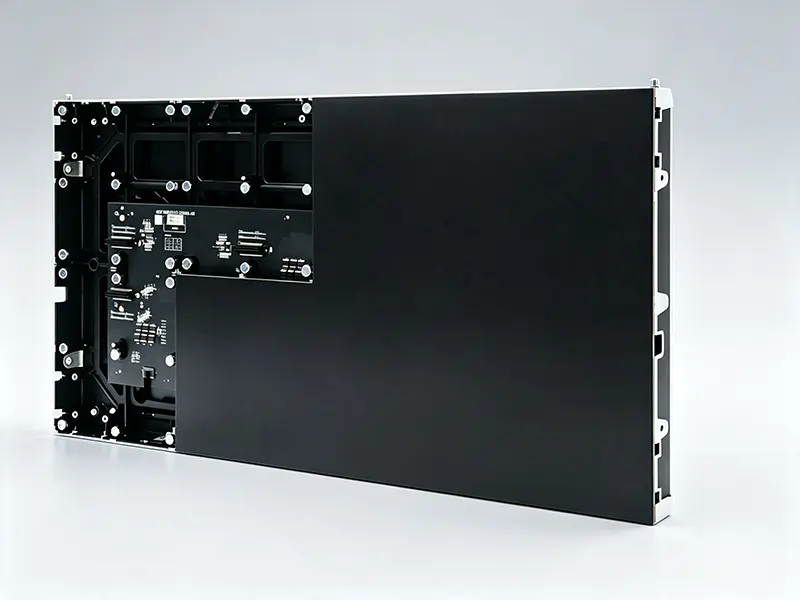
GOB adds a transparent protective layer over the LED module, significantly improving durability while maintaining the image quality advantages of SMD technology.
Today, GOB is widely used in conference rooms, education, retail, museums, transportation hubs, and rental LED displays where screen protection is a priority.
In this guide, you’ll learn:
- What GOB LED technology is
- How GOB differs from standard SMD displays
- Manufacturing process
- Advantages and limitations
- Typical applications
- Frequently asked questions
Contact Us to Discuss Your Project Today
What Is SMD LED Technology?
GOB stands for Glue-on-Board.
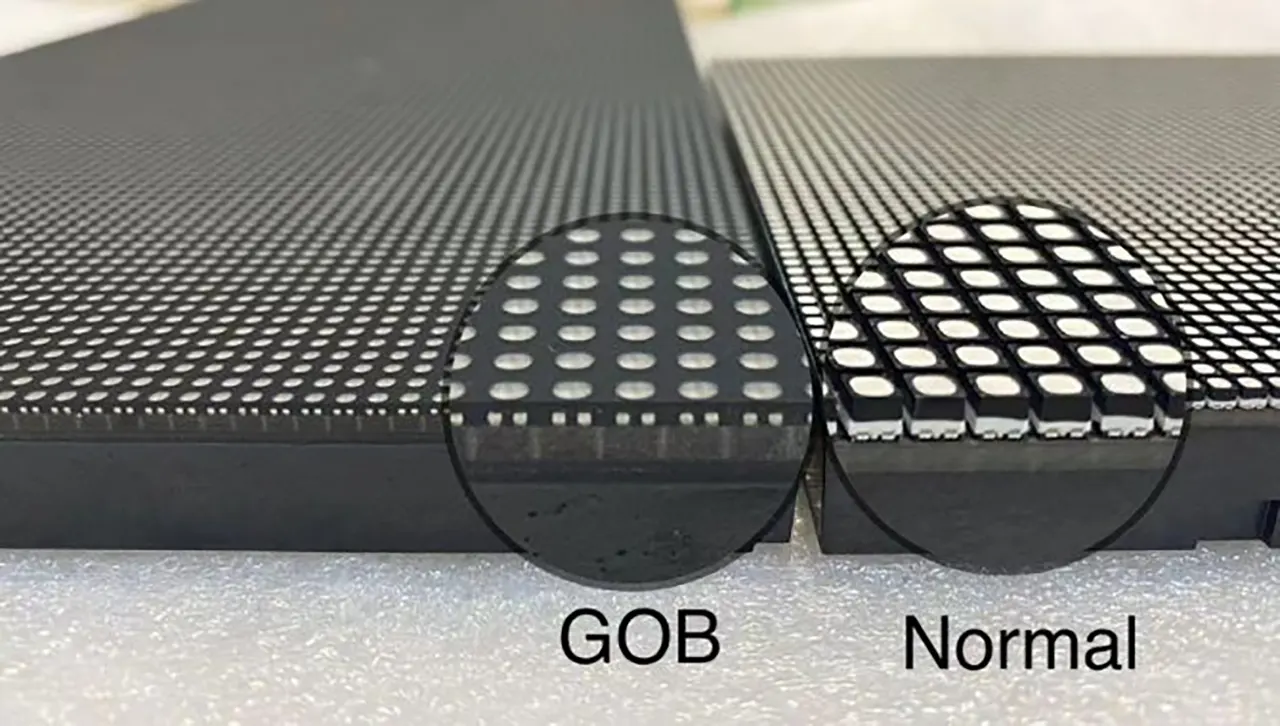
Unlike a conventional SMD LED display, GOB technology applies a specially formulated transparent optical resin over the entire LED module surface.
This protective layer encapsulates the LED packages while allowing light to pass through with minimal loss.
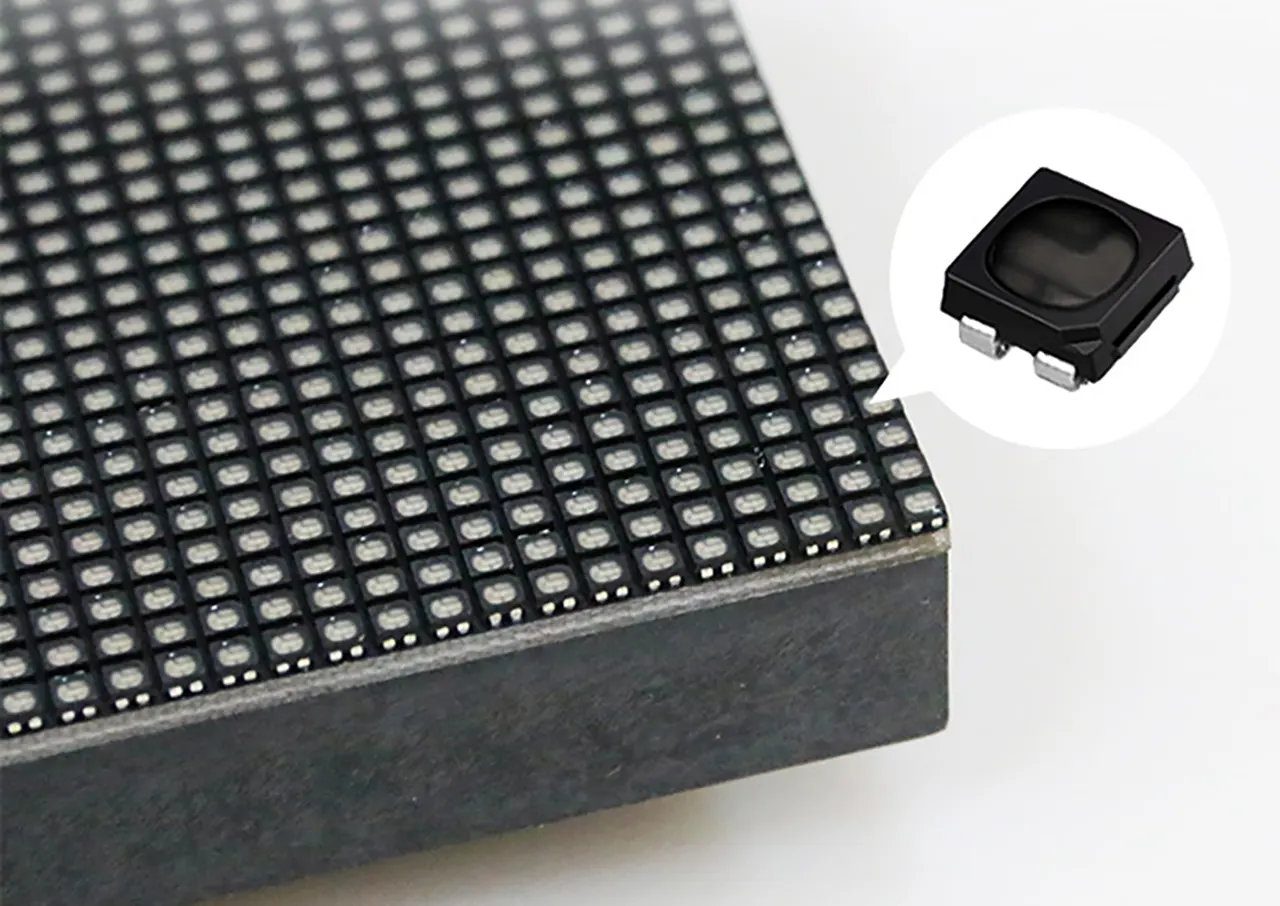
Standard SMD Structure
In a conventional SMD display:
- LED packages remain exposed
- Individual LEDs are visible
- Direct contact may damage pixels
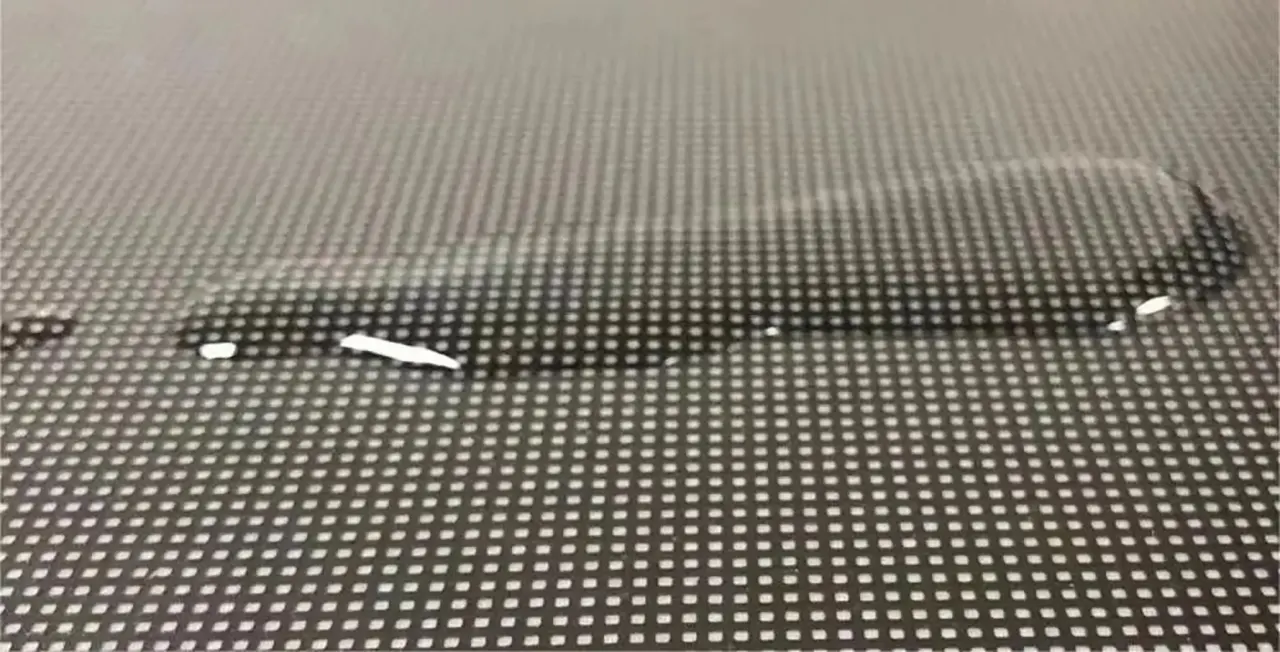
GOB Structure
In a GOB display:
- Transparent resin covers the module
- LEDs are protected from impact
- Surface becomes more durable
- Dust and moisture resistance improves
Think of GOB as adding an invisible armor layer over the LED module.
Why Was GOB Technology Developed?
As pixel pitch becomes smaller, LED packages become increasingly fragile.
For example:
| Pixel Pitch | LED Package |
|---|---|
| P2.5 | SMD2020 |
| P1.8 | SMD1515 |
| P1.2 | SMD1010 |
| P0.9 | Mini SMD |
As LEDs become smaller:
- Mechanical strength decreases
- Repair frequency increases
- Transportation risk rises
GOB was developed specifically to address these challenges.
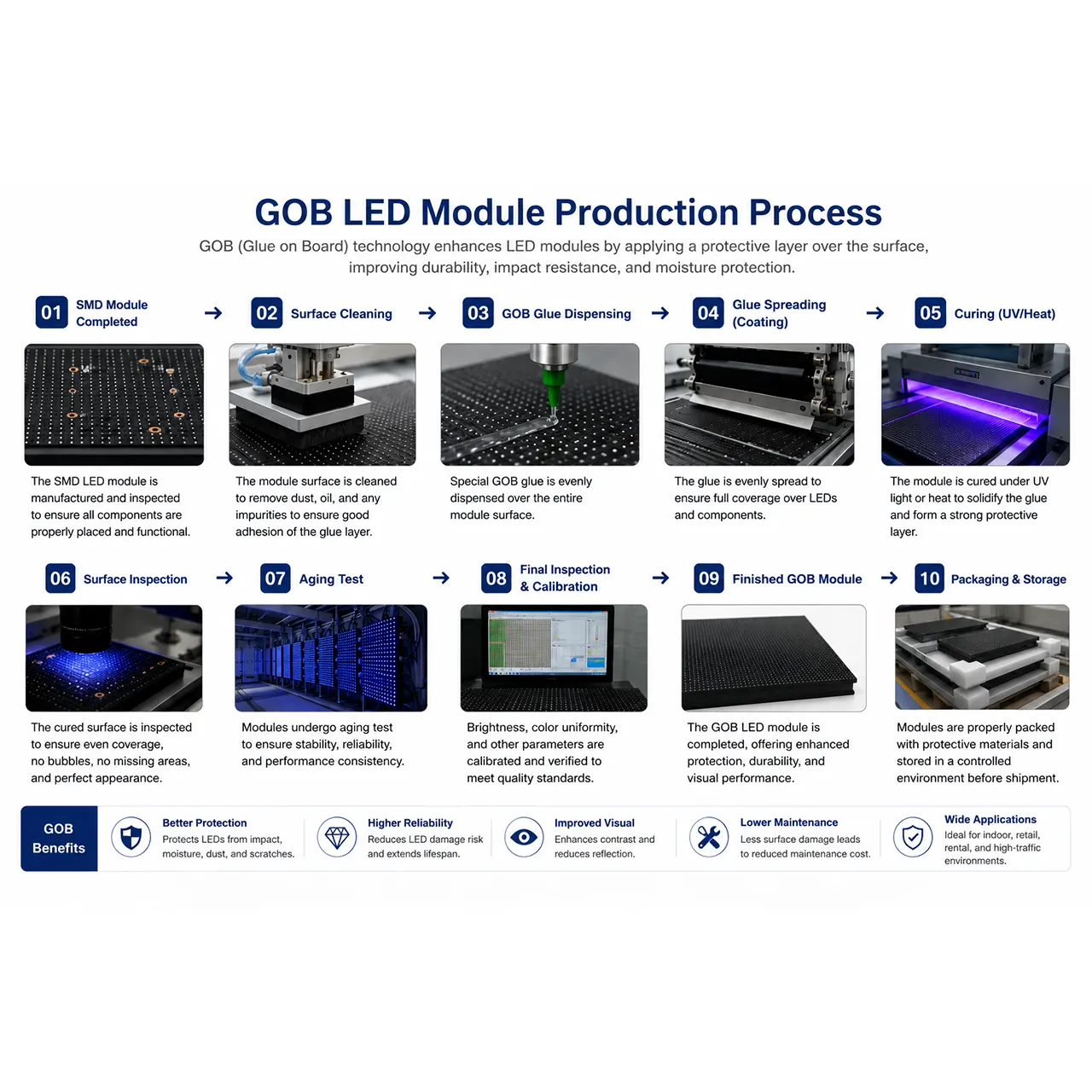
How GOB LED Displays Are Manufactured
Step 1: Standard SMD Production
The LED module is manufactured using traditional SMD technology.
Step 2: Surface Cleaning
The module surface is cleaned to remove contaminants.
Step 3: Resin Dispensing
A specially engineered optical adhesive is applied over the module.
Step 4: Vacuum Degassing
Air bubbles are removed to ensure optical clarity.
Step 5: Curing Process
The resin is cured under controlled temperature conditions.
Step 6: Quality Inspection
Manufacturers inspect:
Surface flatness
Optical performance
Adhesion quality
Impact resistance
Key Advantages of GOB Technology
1. Enhanced Physical Protection
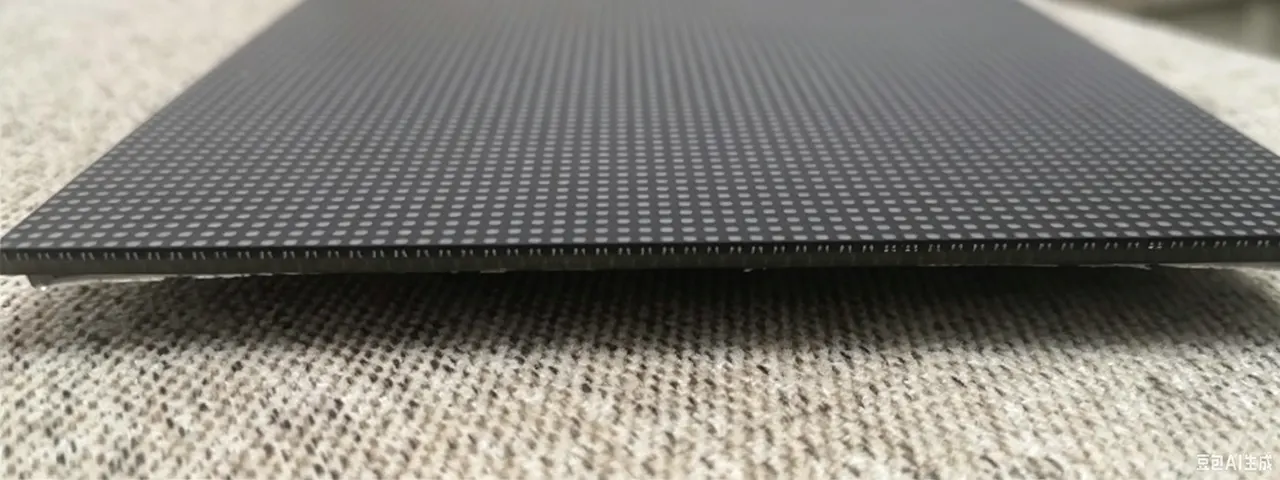
One of the biggest advantages of GOB is mechanical protection.
The protective layer helps prevent:
- Dead pixels caused by impact
- Damage during installation
- Transportation-related failures
- Accidental touch damage
This is particularly valuable for fine-pitch displays.
2. Better Dust and Moisture Resistance
The protective coating seals gaps between LED packages.
Benefits include:
- Improved moisture resistance
- Reduced dust accumulation
- Easier cleaning
- Improved reliability
This makes GOB suitable for challenging indoor environments.
3. Improved ESD Protection
Electrostatic discharge can damage LED chips.
GOB helps reduce ESD-related failures by isolating exposed components from direct contact.
This is particularly important in:
- Schools
- Public venues
- Retail environments
4. Higher Reliability During Transportation
Fine-pitch LED displays often suffer damage during shipping.
GOB protection significantly reduces:
- Pixel loss
- Surface scratches
- Installation damage
For export projects, this can lower maintenance costs and improve customer satisfaction.
5. Touch-Friendly Surface
Unlike conventional SMD displays, GOB screens can tolerate occasional contact with the display surface.
This makes them ideal for:
- Interactive displays
- Education environments
- Museums
- Experience centers
Does GOB Affect Image Quality?
A common concern is whether the protective layer reduces image performance.
Modern GOB materials are engineered to maintain:
- High transparency
- Color accuracy
- Brightness consistency
In high-quality GOB products, visual differences are often minimal.
However, lower-quality GOB manufacturing may introduce:
- Light diffusion
- Reduced sharpness
- Surface reflection
This is why resin quality and manufacturing experience matter.
GOB vs Standard SMD
| Feature | Standard SMD | GOB |
|---|---|---|
| Image Quality | Excellent | Excellent |
| Impact Resistance | Moderate | High |
| Moisture Protection | Moderate | High |
| Dust Protection | Moderate | High |
| Transportation Reliability | Moderate | High |
| Maintenance | Easier | More Complex |
| Cost | Lower | Higher |
GOB vs COB
Many buyers confuse GOB and COB.
These are completely different technologies.
| Feature | GOB | COB |
|---|---|---|
| Base Technology | SMD + Resin | Direct Chip Mounting |
| Protection Level | High | Very High |
| Manufacturing Complexity | Medium | High |
| Cost | Medium | Higher |
| Repairability | Better | More Difficult |
| Maturity | Very Mature | Developing Rapidly |
A simple way to understand the difference:
GOB = Protected SMD
COB = New Packaging Architecture
Typical Applications of GOB LED Displays
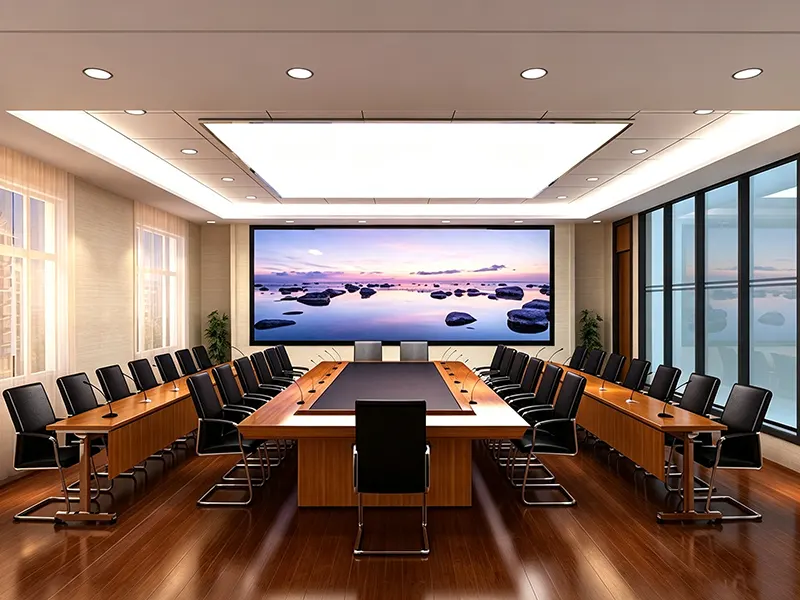
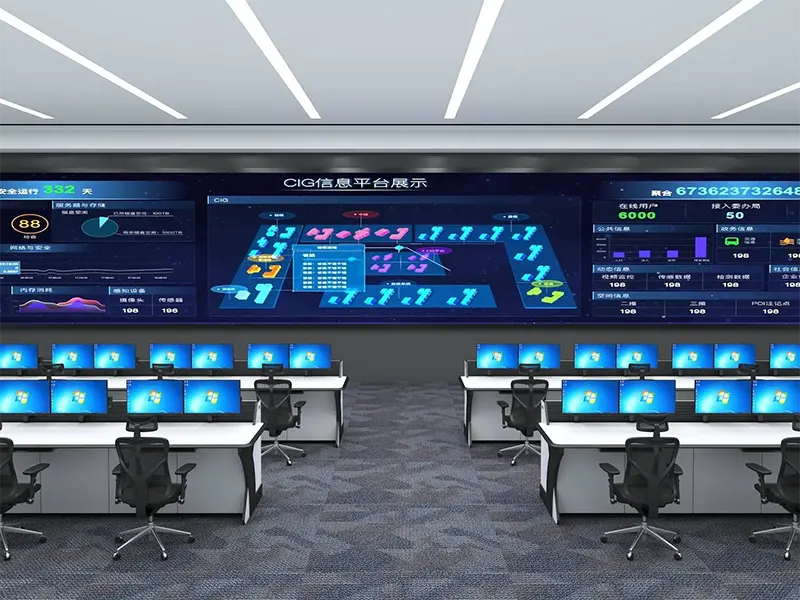
Conference Rooms
Protects displays from accidental contact during daily use.
Education
Ideal for classrooms and training centers where users may touch the screen.
Museums
Provides durability for public-facing installations.
Retail Stores
Improves reliability in high-traffic environments.
Transportation Hubs
Offers enhanced protection against dust and continuous operation.
Rental Applications
Reduces damage during transportation and installation.
Limitations of GOB Technology
While GOB offers many advantages, it is not perfect.
Higher Cost
The additional encapsulation process increases manufacturing costs.
More Difficult Repairs
Repairing LEDs beneath the resin layer can be more challenging.
Quality Depends on Resin
Poor-quality materials may cause:
Yellowing
Optical distortion
Reduced transparency over time
Choosing an experienced manufacturer is essential.
Frequently Asked Questions
1. What does GOB stand for?
GOB stands for Glue-on-Board, a technology that applies a transparent protective resin over an SMD LED module.
2. Is GOB better than standard SMD?
For durability and protection, yes. For applications where protection is less critical, standard SMD may be sufficient.
3. Is GOB the same as COB?
No. GOB is a protective process applied to SMD modules, while COB is a different LED packaging technology.
4. Can GOB be used outdoors?
Some manufacturers offer outdoor GOB solutions, but GOB is most commonly used in indoor fine-pitch applications.
5. Does GOB reduce brightness?
High-quality GOB materials have very high optical transparency, resulting in minimal brightness loss.
Looking for Reliable GOB LED Displays?
Whether you’re designing a conference room video wall, an interactive education display, or a durable retail installation, We can help you choose the right GOB LED solution for your project.
Contact our team today for expert recommendations, technical consultation, and customized LED display solutions.
What Is GOB LED Technology?
A Complete Guide to Glue-on-Board LED Displays
Introduction
As LED displays move toward finer pixel pitches and higher resolutions, durability has become a growing challenge.
Traditional SMD LED displays provide excellent image quality, but exposed LED packages can be vulnerable to accidental impact, dust, moisture, and electrostatic discharge (ESD). This is particularly problematic in environments where people can easily touch the display surface.
To solve these issues, manufacturers developed GOB (Glue-on-Board) technology.
GOB adds a transparent protective layer over the LED module, significantly improving durability while maintaining the image quality advantages of SMD technology.
Today, GOB is widely used in conference rooms, education, retail, museums, transportation hubs, and rental LED displays where screen protection is a priority.
In this guide, you’ll learn:
- What GOB LED technology is
- How GOB differs from standard SMD displays
- Manufacturing process
- Advantages and limitations
- Typical applications
- Frequently asked questions
Contact Us to Discuss Your Project Today
What Is SMD LED Technology?
GOB stands for Glue-on-Board.
Unlike a conventional SMD LED display, GOB technology applies a specially formulated transparent optical resin over the entire LED module surface.
This protective layer encapsulates the LED packages while allowing light to pass through with minimal loss.
Standard SMD Structure
In a conventional SMD display:
- LED packages remain exposed
- Individual LEDs are visible
- Direct contact may damage pixels
GOB Structure
In a GOB display:
- Transparent resin covers the module
- LEDs are protected from impact
- Surface becomes more durable
- Dust and moisture resistance improves
Think of GOB as adding an invisible armor layer over the LED module.
Why Was GOB Technology Developed?
As pixel pitch becomes smaller, LED packages become increasingly fragile.
For example:
| Pixel Pitch | LED Package |
|---|---|
| P2.5 | SMD2020 |
| P1.8 | SMD1515 |
| P1.2 | SMD1010 |
| P0.9 | Mini SMD |
As LEDs become smaller:
- Mechanical strength decreases
- Repair frequency increases
- Transportation risk rises
GOB was developed specifically to address these challenges.
How GOB LED Displays Are Manufactured
Step 1: Standard SMD Production
The LED module is manufactured using traditional SMD technology.
Step 2: Surface Cleaning
The module surface is cleaned to remove contaminants.
Step 3: Resin Dispensing
A specially engineered optical adhesive is applied over the module.
Step 4: Vacuum Degassing
Air bubbles are removed to ensure optical clarity.
Step 5: Curing Process
The resin is cured under controlled temperature conditions.
Step 6: Quality Inspection
Manufacturers inspect:
Surface flatness
Optical performance
Adhesion quality
Impact resistance
Key Advantages of GOB Technology
1. Enhanced Physical Protection
One of the biggest advantages of GOB is mechanical protection.
The protective layer helps prevent:
- Dead pixels caused by impact
- Damage during installation
- Transportation-related failures
- Accidental touch damage
This is particularly valuable for fine-pitch displays.
2. Better Dust and Moisture Resistance
The protective coating seals gaps between LED packages.
Benefits include:
- Improved moisture resistance
- Reduced dust accumulation
- Easier cleaning
- Improved reliability
This makes GOB suitable for challenging indoor environments.
3. Improved ESD Protection
Electrostatic discharge can damage LED chips.
GOB helps reduce ESD-related failures by isolating exposed components from direct contact.
This is particularly important in:
- Schools
- Public venues
- Retail environments
4. Higher Reliability During Transportation
Fine-pitch LED displays often suffer damage during shipping.
GOB protection significantly reduces:
- Pixel loss
- Surface scratches
- Installation damage
For export projects, this can lower maintenance costs and improve customer satisfaction.
5. Touch-Friendly Surface
Unlike conventional SMD displays, GOB screens can tolerate occasional contact with the display surface.
This makes them ideal for:
- Interactive displays
- Education environments
- Museums
- Experience centers
Does GOB Affect Image Quality?
A common concern is whether the protective layer reduces image performance.
Modern GOB materials are engineered to maintain:
- High transparency
- Color accuracy
- Brightness consistency
In high-quality GOB products, visual differences are often minimal.
However, lower-quality GOB manufacturing may introduce:
- Light diffusion
- Reduced sharpness
- Surface reflection
This is why resin quality and manufacturing experience matter.
GOB vs Standard SMD
| Feature | Standard SMD | GOB |
|---|---|---|
| Image Quality | Excellent | Excellent |
| Impact Resistance | Moderate | High |
| Moisture Protection | Moderate | High |
| Dust Protection | Moderate | High |
| Transportation Reliability | Moderate | High |
| Maintenance | Easier | More Complex |
| Cost | Lower | Higher |
GOB vs COB
Many buyers confuse GOB and COB.
These are completely different technologies.
| Feature | GOB | COB |
|---|---|---|
| Base Technology | SMD + Resin | Direct Chip Mounting |
| Protection Level | High | Very High |
| Manufacturing Complexity | Medium | High |
| Cost | Medium | Higher |
| Repairability | Better | More Difficult |
| Maturity | Very Mature | Developing Rapidly |
A simple way to understand the difference:
GOB = Protected SMD
COB = New Packaging Architecture
Typical Applications of GOB LED Displays
Conference Rooms
Protects displays from accidental contact during daily use.
Education
Ideal for classrooms and training centers where users may touch the screen.
Museums
Provides durability for public-facing installations.
Retail Stores
Improves reliability in high-traffic environments.
Transportation Hubs
Offers enhanced protection against dust and continuous operation.
Rental Applications
Reduces damage during transportation and installation.
Limitations of GOB Technology
While GOB offers many advantages, it is not perfect.
Higher Cost
The additional encapsulation process increases manufacturing costs.
More Difficult Repairs
Repairing LEDs beneath the resin layer can be more challenging.
Quality Depends on Resin
Poor-quality materials may cause:
Yellowing
Optical distortion
Reduced transparency over time
Choosing an experienced manufacturer is essential.
Frequently Asked Questions
1. What does GOB stand for?
GOB stands for Glue-on-Board, a technology that applies a transparent protective resin over an SMD LED module.
2. Is GOB better than standard SMD?
For durability and protection, yes. For applications where protection is less critical, standard SMD may be sufficient.
3. Is GOB the same as COB?
No. GOB is a protective process applied to SMD modules, while COB is a different LED packaging technology.
4. Can GOB be used outdoors?
Some manufacturers offer outdoor GOB solutions, but GOB is most commonly used in indoor fine-pitch applications.
5. Does GOB reduce brightness?
High-quality GOB materials have very high optical transparency, resulting in minimal brightness loss.
Looking for Reliable GOB LED Displays?
Whether you’re designing a conference room video wall, an interactive education display, or a durable retail installation, We can help you choose the right GOB LED solution for your project.
Contact our team today for expert recommendations, technical consultation, and customized LED display solutions.



 +86 19075683597
 Shenzhen, China